I want every piece of the new Carrie K. fine jewellery Modern Heirloom collection

I’m in love with the new Modern Heirloom fine jewellery collection from Singapore artisan jeweller Carrie K.

Everyone who knows me even a little bit knows I love rings, and more recently, earrings. Likewise, they know that one of my favourite places to buy jewellery brands is from Singapore artisan jeweller, Carrie K.

So you can imagine my joy when I saw the first pieces of its newest collection, Modern Heirlooms.
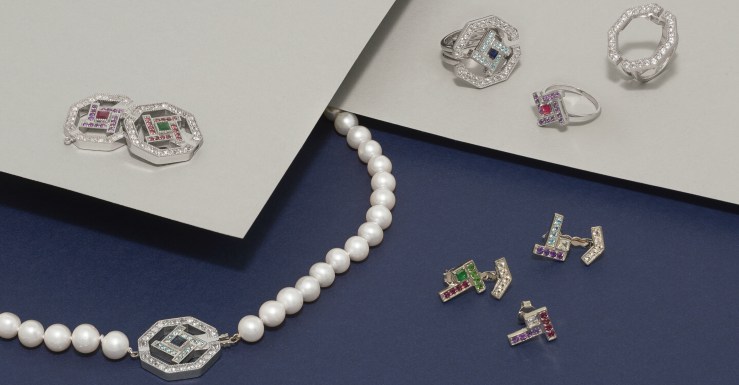
singapore jeweller carrie k heritage fine jewellery collection 1
The Modern Heirloom fine jewellery collection. Image: Carrie K.

The thing that makes Carolyn Kan – the founder and designer of Carrie K – such an interesting jeweller, is her dedication to creating pieces that are somehow attached to her Singapore heritage but that look nothing like an obvious recreation.

There is always a certain consideration that Carolyn applies when she designs; she doesn’t take the most obvious route towards referencing ‘local flavour’, and generally designs first from a point of genuine interest and love for the things that make Singapore special. She also has a quirky sense of humour.

Carolyn is basically the nicest person in the world too. #justsaying

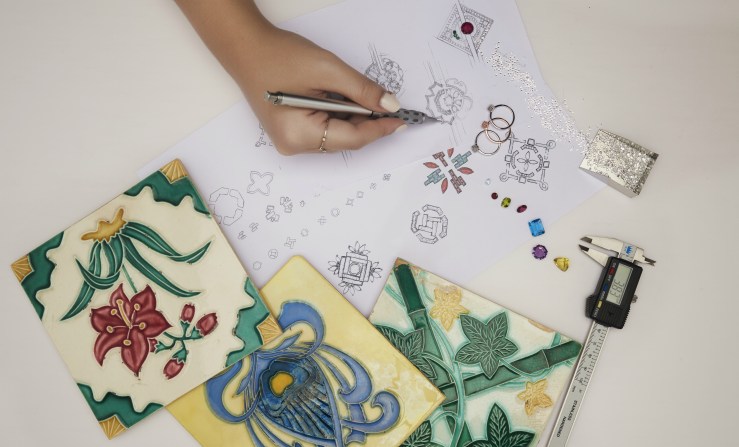
The new Modern Heirloom fine jewellery collection has been inspired by Singapore’s Peranakan heritage, in particular the colourful traditional tiles. But unlike just about every fashion student I’ve ever had the misfortune to critique, Carolyn didn’t just go with over-wrought patterns of teal, fuschia and lemon.  
singapore jeweller carrie k heritage fine jewellery collection 2
The Modern Heirloom fine jewellery collection. Image: Carrie K.

Although the designs were based on the stylised plants and animals of the traditional tiles that can be found across Singapore from Chinatown to Little India and Geylang Serai, when you look at the geometric and streamlined jewellery pieces the connection does not smack you in the face.

“The Modern Heirloom Collection was designed to create relevant interpretations of important elements of our Singapore Heritage in the hope that these meaningful reminders will be handed down to future generations,” says Carolyn.

There is a very Art Deco feel to the designs overall, including the sharp lines, the pearls and the fact that Carolyn chose to use white gold instead of yellow for the settings. The colours come from rubies, emeralds, blue sapphires and diamonds and well as semi-precious stones such as amethyst, peridot, topaz, and jade.

singapore jeweller carrie k heritage fine jewellery collection Heritage Long Pearl Necklace
The Modern Heirloom fine jewellery collection. Image: Carrie K.

As well as the refined, pared-back aesthetic, Carolyn has continued her penchant for mechanical things by fiddling with the designs to include multiple functions. There’s an ‘over ring’ that you wear with the core Heritage Rings; this creates an impressive cocktail ring that you can breakdown into a smaller everyday piece. As with all Carrie K. pieces, the designs come in a number of price points. Starting from only SG$288 for the silver version of the Heritage Outer Ring with topaz, that you pair with a silver and ruby, blue sapphire or emerald Heritage Ring for SG$388. You can also splash out on a luxe version that is made of 9 karat gold with a great emerald for SG$1,288.

singapore jeweller carrie k heritage fine jewellery collection Heritage Styled Ring Sapphire
The Modern Heirloom fine jewellery collection Heritage Ring. Image: Carrie K.

Another inspiration for Carolyn for the Modern Heirloom collection was Si Dian Jin – usually connected to weddings but actually based on the Chinese concept of ‘four generations under one roof’. You can also see echos of this concept in the architecture of the traditional Chinese four-pointed roof. That concept is where the overall design of the rings comes from – the outer ring with four ‘points’ and the inner ring with four stones that represent the four generations.
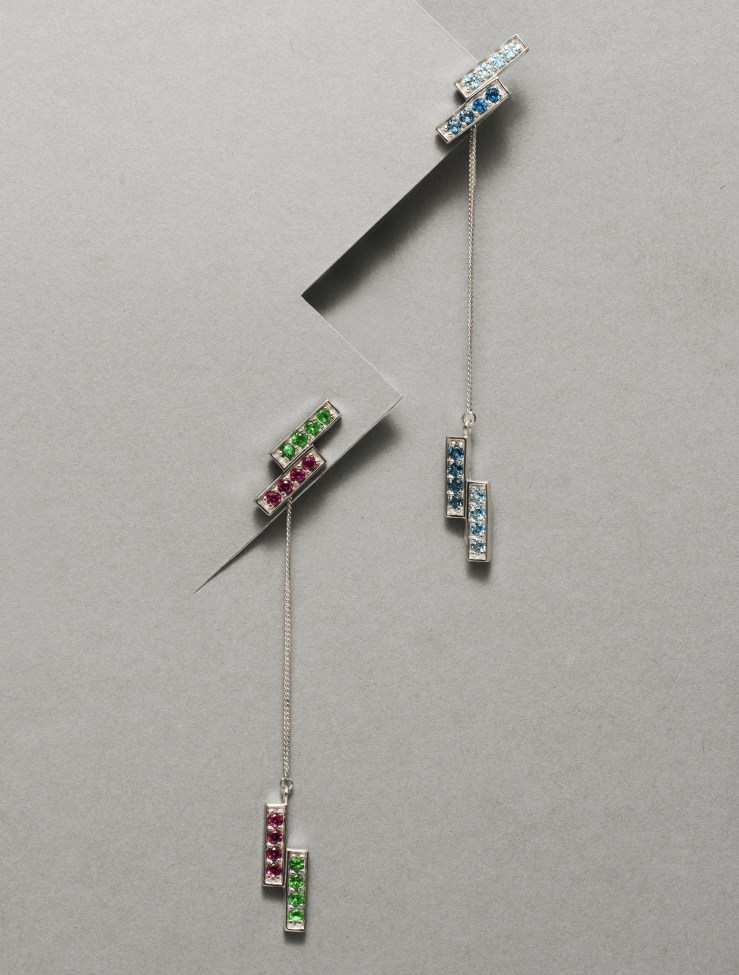
singapore jeweller carrie k heritage fine jewellery collection Heritage Ear Drops
The Modern Heirloom fine jewellery collection Heritage Ear Drops. Image: Carrie K.

The rings are obviously my favourite pieces, but the earrings are damn nice too. Like the rings, the earrings are also multifunctional – the Heritage Ear Drops can be worn either as simple studs or with the additional ‘drops’ which you can buy separately. Prices range from $368 to $588 depending on the type of stones you choose. Top of the line is the pair that comes in 9 karat gold with amethyst and London blue topaz or white topaz which cost $1,488. I’m also loving the studs in rhodalite garnet or dark tarvorite garnet for $1,188.

Basically I’m impressed with the whole collection – as if that’s not obvious. I just have to work out how to pay for all the pieces I want.

The Carrie K. Heritage fine jewellery collection is available from the new Carrie K. Fine Jewellery Atelier located at #02-02 National Design Centre. The atelier will feature the custom and bespoke services, and you can shop for the ready-to-wear Carrie K. collection at the Keepers PlayShop at #01-01 National Design Centre.
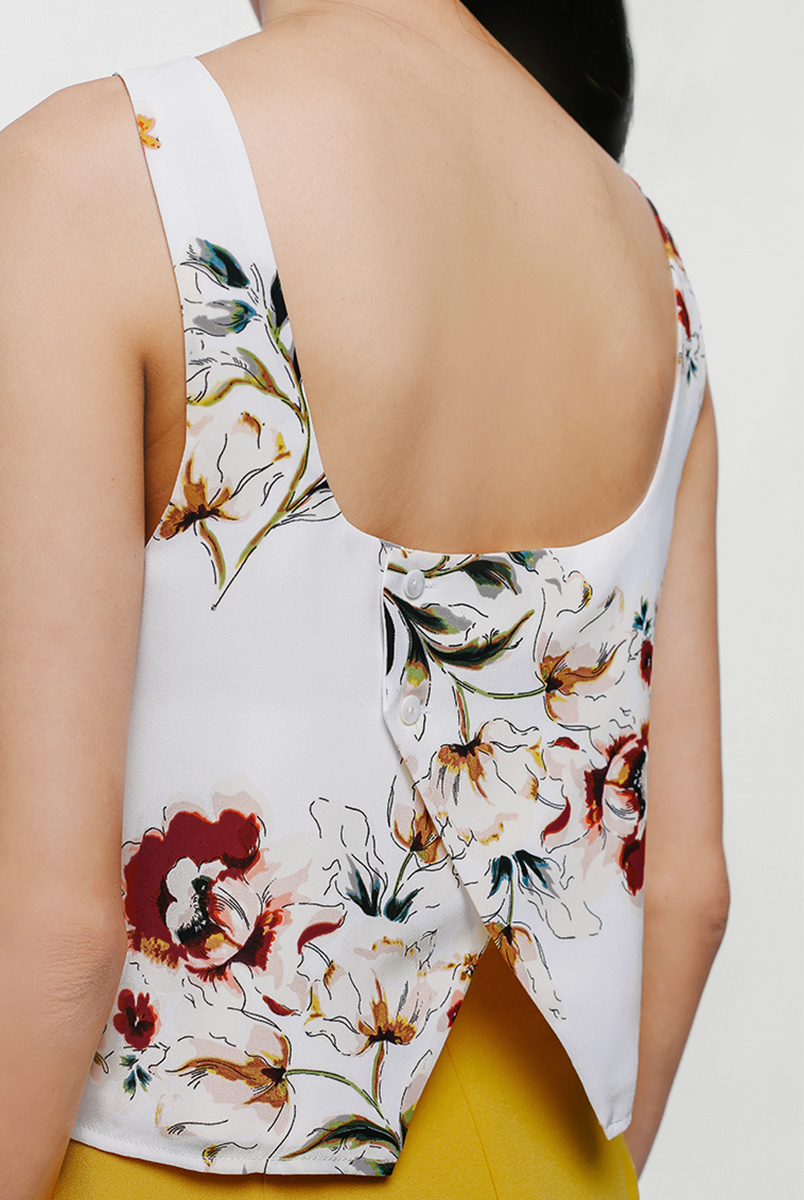
Why Love Bonito isn’t a fashion brand, and why that’s not a bad thing … also something about the Singapore fashion plagiarism controversy

For a long time I’ve had an issue with Singapore media describing certain companies that make clothes as ‘fashion brands’ but which are actually ‘retail’ labels. These brands – Love, Bonito is one of them – are not really ‘fashion brands’; they are companies that make nice clothes, at reasonable prices, with a bit of personal style, for people to wear on a daily basis. These brands are more similar to Topshop and Uniqlo than they are to Dior or Chanel, or even Vetements.

In Singapore there are number of quite successful retail brands that have been making their way into popular shopping memories, but which are not fashion brands per se. Brands like Love, Bonito, By Invite Only, Beyond the Vines and Benjamin Barker, were recently featured at the Singapore Fashion Awards 2017, as part of the ‘marketing’ section, not as part of the design awards. And having been a founding judge for the awards, I know that the reason these brands are featured is because they are popular and much more retail-friendly than many less wearable or conceptual designer brands. Designer brands that are more appropriate to be considered as ‘fashion’ labels.

Now, don’t get me wrong. I’m not saying that more retail-friendly brands are worse than the more fashion-forward labels. What I’m trying to highlight is that these types of clothing companies are not ‘oranges and apples’, they’re more ‘oranges and coffee-smoked buffalo tongue’. The first is something that doesn’t scare the shopper, the second is only for the very adventurous.

I have a great deal of respect for Love, Bonito’s founders. They have created a very lucrative business in a fashion retail environment that’s been under a great deal of pressure for the last 2-3 years. The brand knows exactly who their customer is; they know what she wants; and they know how to give it to her in a seamless online-to-offline experience. The brand has a variety of price points, but retains its core directive from its launch, expanding only as much, and as directionally, as is needed to grow the business. Love, Bonito is not a fashion brand swinging on the weird wind of trends and concepts; it’s sailing along smoothly along in a clear direction. And this is not a bad thing.

_l7a8767-2_5
Image from Love, Bonito Chinese New Year 2018 capsule collection. Model: Jasmine Sim

While I may not consider Love, Bonito to be a hardcore fashion brand – you can read about the Singapore brands I do consider more ‘fashion’ – the founders have never claimed it is one. They are purposefully creating a business that has long term prospects in the retail market.

Unfortunately, there are a number of so-called fashion brands based in Singapore that claim to be something they’re not. The most obvious is the ‘celebrity’ brand Exhibit by Yoyo Cao. It showed at Singapore Fashion Week 2017, and had some obvious problems. There were distinct issues about plagiarism, so bad in fact that cult fashion Instagram account Diet Prada dedicated an entire post to Yoyo Cao’s label’s knock-offs. Considering that Yoyo is a certified fashionista, it really was remarkably naive to think that no one would notice.

There are a few other Singapore brands that are also not exactly pristine when it comes to plagiarism. Whole9Yards has been cited for knocking off first, Self Portrait – the classic coloured lace dresses of its earliest collections – and now Malaysian designer, Jonathan Liang. Pleatation is obviously a copy of Issey Miyake’s Pleats Please label.

For Pleatation, the concept arose at the same time as micro pleated skirts started flooding Zara and Topshop; the brand cleverly linked up with this trend.

JLSS17-24
Image from Jonathan Liang SS17

When Whole9Yards first launched there was not a whole lot to talk about. The design concept was very ‘office lady’. However, after Self Portrait’s iconic lace dresses took off in 2013, Whole9Yards began to specialise in lace dresses the average OL could afford. The lace dress became a staple of its output. And very successful it was too. Although I’ve noticed that the brand has massively increased their prices now that they’re doing items that look like those of Jonathan Liang.

front_3_22
Image from Whole9Yards AW17

Again, I’m not saying that affordable retail options are an entirely bad thing. What I am saying is that making items that so closely echo the creative work of other designers is not fashion; it is copying. It is the lack of original design coupled with riding a wave of commercial popularity that makes it ‘retail’ and NOT fashion. At least as far as I’m concerned.

As I was quoted in this very flattering story by Adele Chan, the Editor-in-Chief of Nylon Singapore … As always, I want to remind readers that this is my personal opinion, and as with anything, you can always have your own.”