Why you need to shop consciously, and where to do it

Gone are the days when the only things you cared about when shopping were either the price or how on-trend something was. Now, with changes not only to the environment, but also towards how we want to be perceived in the world, people are thinking more consciously about how, and on what, they spend their money.

For many of us, buying a fun new dress or tee for under $30 is a no-brainer; we see, we like, we buy. However, for a lot of other Singaporeans it has now become more important to know exactly what it is they’re adding to their wardrobes, their homes or using on their skin.

“I like to shop consciously because I feel like I have more of an emotional connection with my purchases,” says Susannah Jaffer, the owner of Zerrin, a Singapore based curated online store that features brands with “meaningful stories” and great design. “I think as women, caring more about the things we buy and valuing them in a new way is the first step towards shopping more sustainably – and ultimately buying less but better.”

For Tim O’Hanlon, a writer who previously worked for Lonely Planet, shopping consciously is about choosing the right brands. “My version of shopping consciously is picking brands I know have a reputation for quality and are long-lasting over fast fashion,” he says.

“This is because – I at least have the impression that – they treat their manufacturing staff better and are more conscious of their impact, plus as they pander less to quick trends they produce less and don’t encourage a throw-away lifestyle in their customers. Finally, as the items are of vastly better quality I can wear/use them for a long time so it lowers my own impact.”

This article was first published on Yahoo Lifestyle Singapore. Read the full story HERE.

Opinion: Is fashion dead? And should we care?

Every year pundits around the world make pronouncements about the end of something – television, radio, newspapers etc. In the world of people who like clothes, it is now the turn of the fashion industry.

Is fashion, the influential social phenomenon of telling you what to wear, when and why, finally dead? And if it is, does it really matter?

On February 19, just days before the Chanel Autumn Winter 2019 runway show, Karl Lagerfeld, the outspoken doyenne of 20th century fashion and the mastermind behind the rise of Chanel, died after a short illness.

Fashion fans and industry stalwarts around the world bemoaned his passing, his praises rang to the skies and littered the internet for days. For non fashion fans, it was often the first time they had even heard of the man.

And that is the crux of the current situation of fashion as a global industry. It’s not so much the brands that fashionistas name drop, it’s the rest of the world who buy basic clothes to wear.

Gone are the days of people making their own clothes at home, now it’s all about getting what you want from your phone, delivered to your doorstep, and with little to no thought about how it was made or where it came from.

I recently came across a fantastic quote from William McDonough, an expert in the realm of architecture, community design and consulting based on the Cradle to Cradle philosophy – where products need to be considered from the day they are built, to the day they are recycled into something else.

The quote pointed out that ‘fashion’ is actually a verb; a doing word. We ‘fashion’ something, we make something. Fashion as a noun, as it is used today, is a mutation of the concept of creating clothes (or anything else for that matter).

If you think about modern fashion, when everything is manufactured by machines and shipped around the world in hours or days, we are not ‘fashioning’ anything. We are simply consuming clothes.

Which is where the idea of the ‘death of fashion’ arrives. The massive Fashion Industry that will be worth about US$325.8 billion in 2022, is certainly not dying. But the concept of the glamorous, unique and interesting world of Fashion as a craft-based business, as a set of ‘rules’ to dress by, does seem to be declining.

This article was first published on Yahoo Lifestyle Singapore. Read the rest of the story HERE.

Microfactories, digital printing, downloadable patterns … Our dystopian future?

When I was recently sent links to the newly launched Pattern Room – an online, downloadable pattern provider – and the new Microfactory from Gerber – a set-up that can design, print the fabric, cut and sew a garment all at once in a small space – I have to say I wasn’t sure I should be excited or dismayed.

Having just spent the last couple of months working on a sustainability project with RMIT and Inditex (Zara) to try to find a way to make their shoe production less wasteful, and also having been struck by a recent story asking the question as to whether or not we actually NEED more sustainable fashion brands, I can’t decide if this new technological development is a boon or bane for the fashion industry. 

Yes, these new technologies make it easier for small brands to produce products locally without the issues of carbon footprint, large factory ethical or environmental issues, but do we really NEED more products? 

There are so many clothes already in the world, most of them ending up in landfill after having been produced in an environmentally damaging way. 

Even if the clothes HAVE been produced in a somewhat more sustainable fashion, we just don’t need more of them. 

This is really the core issue of what needs to be thought about regarding fashion and sustainability; we already have too many clothes, so do we need the ability to make millions more, more quickly, and less considered than is already the case?

Less volume, more quality …
From a more personal perspective, what concerns me about the production from the Microfactory and the use of Pattern Room, is the lack of quality in design. 

Yes, the digital printing they use is dry – no water – and apparently the inks are non toxic – but this is digital printing. It is single surface and will eventually fade. This produces fabrics that do not have the beauty and long-lasting nature of traditional wovens like brocade etc. 

The use of a pattern bank and a machine to laser-cut flats removes the possibility of creative new designs and the traditional talent of the pattern-cutter; it creates a see of same-same clothing. 

I see a future of people wearing ugly-ass same-same silhouette tees and leggings in increasingly nastily coloured disposable synthetic fabric. The world will look like an EDM concert. 

The rich will wear increasingly expensive couture made by hand with ‘real’ fabrics, and the poor will wear nasty digitally printed disposables. A nightmare come true. 

Convince me …
I would prefer to see fewer clothes of better quality being made. If these technological breakthroughs can be directed to allow people to produce fewer, but better made and more sustainable items at home, or in a community microfactory for example, then I can see the advantages. 

However, did Inditex’s streamlined production system produce better clothes for everyone? No. Human nature ie. greed, saw it produce too many crap clothes for everyone. 

I would prefer to just teach everyone to sew.

This article was first published for the iFab newsletter.


Runway shows or bespoke fittings?

I’m totally over runway shows. Ever since Instagram arrived the major fashion brands have been trying to top their previous seasons’ runway shows with more and more spectacle. 

For Fall-Winter 2017/18 Ready-to-Wear, Chanel actually stuck a rocket on the runway. Can anyone tell me what the clothes looked like? No. But everyone remembers the damn rocket.

When I first started attending fashion shows (yes, back in the dark ages, because I’m that old), we were treated to seeing the actual clothes making the statements, not the spaces or the runways. 

We saw the clothes on models that had personalities, who didn’t all look and move the same way, and since there weren’t any Influencers in the front rows, we actually were close enough to tell if the clothes were made or wool or silk – and yes, we also knew the difference between those two fabrics too. 

For those of us old enough to have experienced fashion before Instagram we have favourite collections – not favourite ‘experiences’. Mine was Alexander McQueen’s AW 1995-96 Highland Rape.

Can anyone actually remember the title of a recent runway show?

Runway shows are supposed to show you the clothes and concepts of a new collection; it should support the brand’s existing DNA and continue the theme of the collection so that buyers can see how it fits into their future buys. 

Runway shows are not supposed to be multi-million dollar extravaganzas that offer spectacle alone, but no knowledge of a brand’s DNA or the direction of a collection’s theme. 

Runway shows for prêt-à-porter, ready-to-wear, are the worst. They are simply entertainment activities wrapped in a bit of fashion. These days they are used to launch albums (Kanye), show off motocross tricks (Alexander Wang) or show how rich a brand is (everything from Chanel under Kaiser Karl). 

I want to see the clothes. That’s why it’s bespoke all the way for me. 

Even the Haute Couture runway shows are better than the prêt-à-porter shows, they feature nice venues where you can actually SEE the clothes, on models with personalities, and no rockets or icebergs or supermarkets (Ugh, Chanel).

When it comes to sustainable fashion bespoke is also the way to go. Whether its by working with an emerging designer to make new clothes that are timeless and will last forever; or using a sewer to alter something you picked up from a vintage store (or your mother’s wardrobe), going bespoke not only makes environmental sense, it also makes style sense.

You can dress as yourself, and not have to pretend you are a size 0 model.

This article was first published as an iFab newsletter.

Review: A Classic Carla collection

Carla Zampatti is one of Australia’s best-known, most successful and globally recognised fashion designers, and for her Grand Showcase she showed a classic collection.

Over 30 years ago, Carla Zampatti introduced me to the idea that fashion could be a career. As a teenager I attended a talk she gave about how fashion wasn’t a frivolous pastime, but something that could become a job for life.

Obviously the designer practiced what she preached. Zampatti opened her first store in 1972; that’s almost 50 years ago. And she hasn’t stopped working to create the classic Australian woman’s wardrobe.

For her Grand Showcase affaire at VAMFF, Zampatti held her own on the runway – the only brand to have a stand-alone show – with a series of wearable, stylish and elegant looks that held little overt drama but a whole lot of ‘chic’.
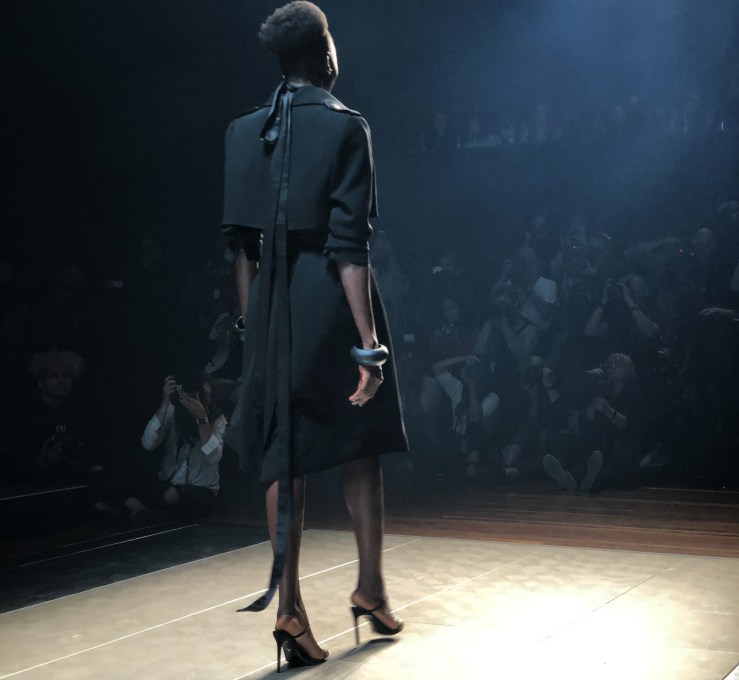
A Classic Carla collection 8

Luckily for me I was seated next to the lovely, warm, friendly and funny Robyn Baillieu, wife of the former Victorian Premier Ted Baillieu.

Chatting about her interest in fashion, especially how innovation is changing the industry, Baillieu said that she, and her two daughters both wore, and loved, pieces from the brand. And as Baillieu happily pointed out looks she loved and some that she already owned, it was clear that Carla Zampatti has developed into a label that suits a wide range of ages.

While the runway show was all about Zampatti as a designer, and the brand, it was also heartening to see so much inclusion on the runway. Globally there has been a lot of talk about the importance of including all races and creeds, and sizes.

While Zampatti featured stunning black models and Asian models, and included two hijabi looks, it would have been fabulous to see a few elegant mature women and women of different shapes on the runway too. Melbourne model Hanan Ibrahim (pictured below) was the first hijab model to walk the runway for Melbourne Fashion Week.

With a soundtrack provided by Eurovision songstress Dani Im supported by Nick Wales, Peter Simon Phillips and Jonny Seymour, the set of the Royal Exhibition Building resounded to a mix of contemporary soul and more instrumental sounds – the perfect accompaniment for the collection that was also a mix of classic and contemporary.

Opening with a series of classic Carla red looks, working through sky blue satin, a glittery houndstooth jacquard, leopard and zebra prints (with added bling), it was the tailoring, coats and jackets that showed why Australian women love the brand.

A stunning boxy double-breasted coat in boucle tweed stood out as one that would stand the test of time; as did a white wool suit with swinging fringe.

A Classic Carla collection 4 fringe

The houndstooth pieces, rather ironically considering the passing of Kaiser Karl, were reminiscent of classic Chanel – a comparison that can never be escaped when using that pattern in black and white. However Zampatti deftly added her own touch with a simple long skirt in once case, and a neat pair of capris in another.
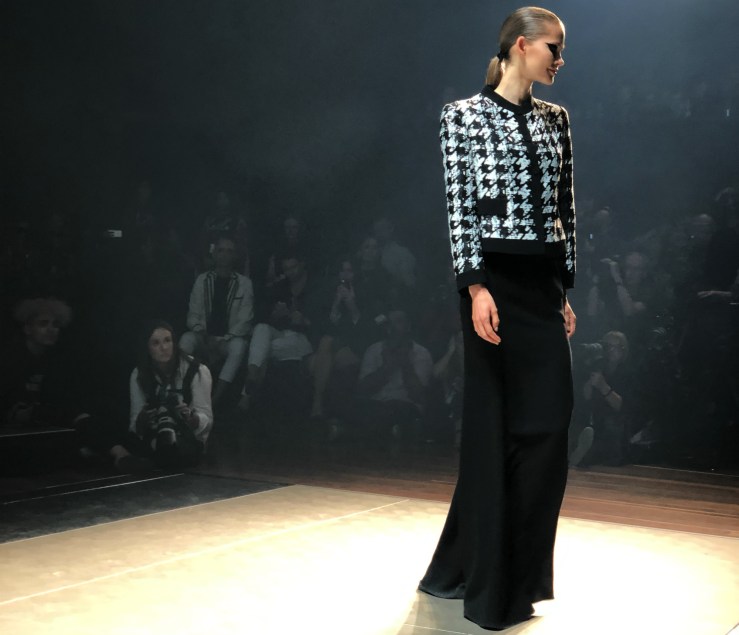
A Classic Carla collection 6 houndstooth

There were a number of capes and capelets; the most successful being a beguiling caramel coat-dress in a lovely suede.

A Classic Carla collection 9 cape

Less successful were a series of graphic evening dresses – one with a mound of maribou, another not quite fitting the model correctly – as they seemed a little too ornate, especially when compared to other evening looks.
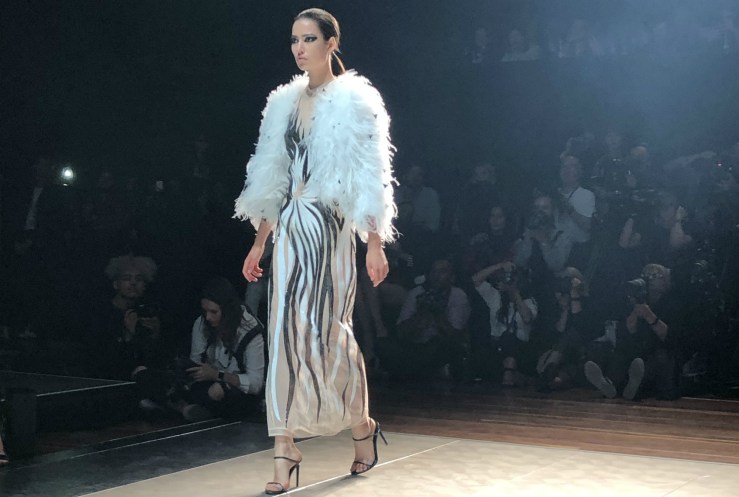
A Classic Carla collection 2 evening feathers

A classic ‘sexy’ mini encrusted in shining sequins and another evening gown that cleverly created a zebra stripe of shimmer seemed more streamlined and elegant.
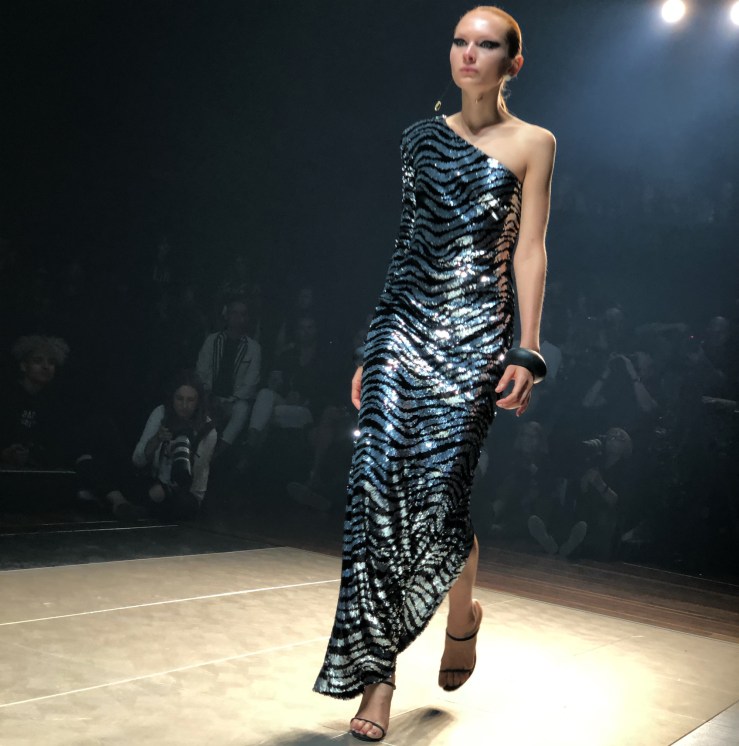
A Classic Carla collection 5 sequins

Perhaps the most interesting and memorable look was a delicately pleated maxi dress with string-sized straps, a low vee neckline and perfect pleats front and back; the cut of the back was done to perfection as it sat proud from the shoulder.

This was a stunning example of quality tailoring, however it didn’t seem to entirely fit the rest of the more classic collection. Perhaps it is a new concept we will see more of in the future.
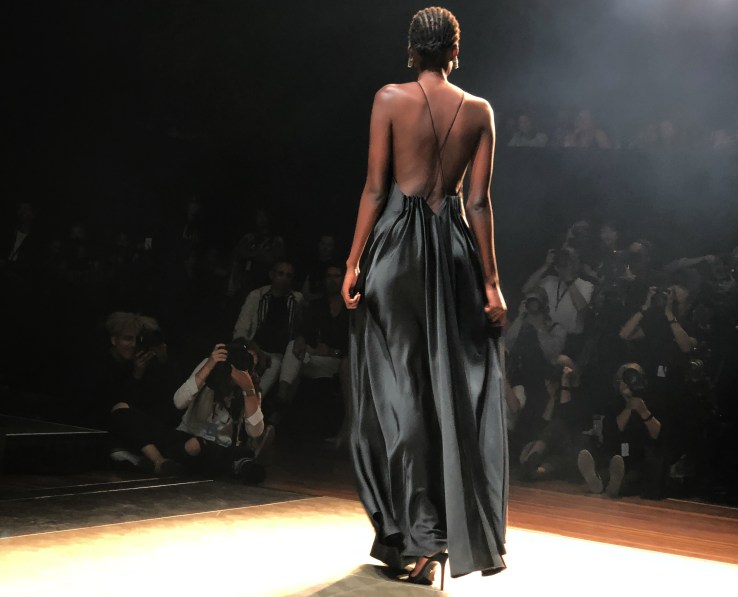
A Classic Carla collection 3 dress black

The show closed with a collection of black evening frocks that were again, more classic than cutting edge, not that this is a bad thing.
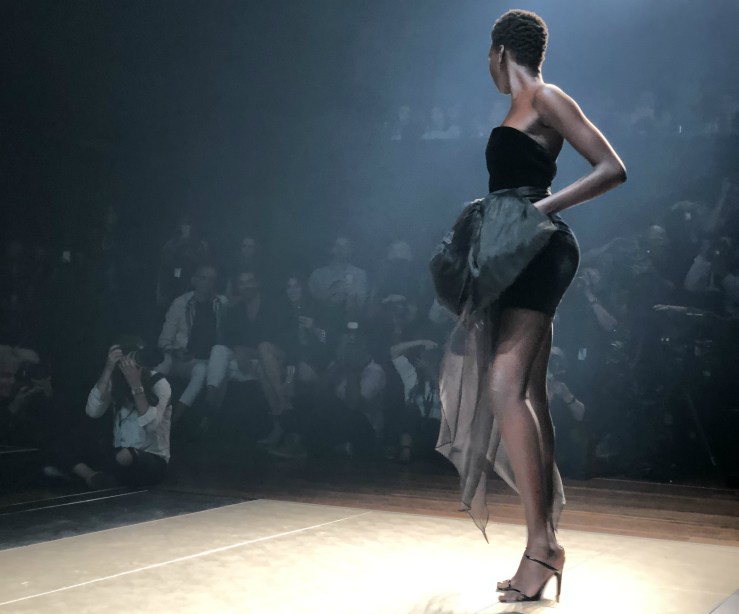
A Classic Carla collection 1 evening

Since the fashion industry currently appears to be having a crisis of conscience around the issues of sustainability and ethical fashion, it may be time to invest your money in pieces that will always look stylish, rather than just jump on a passing trend.

As the show ended, Zampatti received a standing ovation. Not many designers, even the big names in Paris, get that.

I attended VAMFF as part of its Writers Programme.
 

The future of fashion must be sustainable, and kind

Sustainable fashion, slow fashion, closed circular fashion production system … all these things are the future of fashion and we need to start doing them now.

At the Future Fashion. Is it a stitch up? conversation held as part of VAMFF’s Independent Ideas Event series, and in collaboration with The Possibility Project, a group of like-minded individuals came together to examine the future of the fashion industry in Australia and beyond.

future of fashion must be sustainable 2
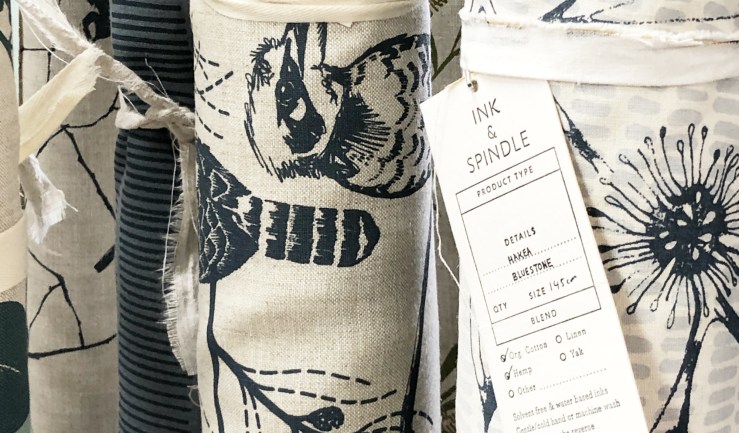
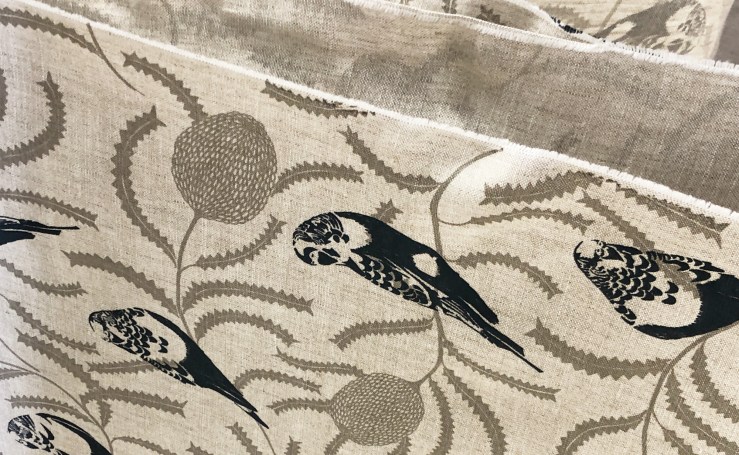
Examples of fabrics from Ink & Spindle, an Australian brand that create textiles that have a minimal impact on the earth. The brand uses organic cotton/hemp and eco-linen basecloths for their prints that are free from harmful chemicals. .

With Kim Pearce from The Possibility Project and slumwear108, Marnie Goding, the Creative Director of fashion label ELK, and Karina Seljak co-founder of Seljak Brand on the panel, the focus was on the importance of changing the current fashion industry system, with the hope to improve the overall sustainability of making and wearing clothes; and doing so with kindness and ethical awareness.

As Pearce said: “It is time for the fashion industry to open the conversation, and reimagine the industry in a way that is not all about technology but also about common sense”. She believes that historical fashion choices by both industry and consumers have led to “immense damage”, not only of the environment, but also how people and their work is treated.

Like the Fashion Revolution movement and its popular hashtag #Imadeyourclothes, The Possibility Project focuses on the social movement behind changing people’s shopping choices. They don’t want people to feel guilty about how they shop for clothes, but they do want to educate shoppers about what they’re buying.

future of fashion must be sustainable 3
Fabric from Ink & Spindle.

For Karina Seljak, one of the co-founders of Seljak Brand – an Australian company that makes blankets from recycled wool – getting the technology, machinery and skills behind creating a fully sustainable and closed circular fashion production system is most important when it comes to creating a better fashion system.

“One of the main inhibitors to moving to a closed loop system in Australia is that we are still shipping our textile waste offshore; those recycled products don’t come back to Australia. We need to our on-shore manufacturing to be circular [to make a difference],” explained Seljak.

This issue of waste was also emphasised by Pearce, although her perspective was as much about how human potential is being wasted in the large scale fashion industry.

And waste, plus the sourcing of the right materials, also came up in Marnie Goding’s comments on how her brand ELK currently operates. “In Australia we don’t value our waste products. There is a factory in Vietnam that we work with that completely recycles all of its waste water used in making jeans. They put it back into the environment,” said Goding.

Although Goding wants her brand to be as ethical and sustainable as possible, her core concern is that not just in Australia, but globally, the established manufacturing industry has not kept up with the move towards more sustainable fabrics and textiles. She also mentioned that although ‘sustainability’ is currently a global fashion trend, customers are not yet educated enough to understand why they need to change their shopping habits.

future of fashion must be sustainable 4
The team at Ink & Spindle showing how they hand screen print their eco-friendly fabrics.

Shown by the few questions asked by the audience, all three speakers were preaching to the converted. A few asked about how younger shoppers can be converted when they are focused on cheap prices and social media trends, however apart from discussing the importance of education, and shopping at Op Shops, there was little that the speakers mentioned that could impact in any great way.

While it is obviously important for more people to know about why we need to stop sending clothes to landfill and choosing to buy fewer, better, things, the relatively small turnout for the Future Fashion conversation also showed that a great deal more needs to be done to get the message out. As long as it’s done with kindness.


Founder of Love, Bonito, Rachel Lim, on thriving, not just surviving, in the fashion retail world

The Singapore brand, Love, Bonito, might have begun in 2010 as a ‘blogshop’ but it has now expanded into a multi-outlet bricks ‘n’ mortar lifestyle brand with the opening of its second Singapore store in Jem. This is on top of its flagship store in 313@Somerset, and its two retail stores in Kuala Lumpur. Love, Bonito is obviously thriving, not just surviving the current troubled retail market.

LOOK2-HALF
The latest collection from Love, Bonito. Image: Love, Bonito

Continuing its focus on being a ‘retail friend’ to its customers, the Love, Bonito brand has stepped easily into the new retail world of experiences and technology, its founders becoming social media influencers in their own rights, and their fans becoming loyal customers. Despite the so-called woes of retail, this disruptor fashion brand is powering ahead.

LOOK9-TWINHALF

To discover more about how the brand has grown, developed and succeeded, I got in touch with Rachel Lim, the co-founder of Love, Bonito, and the current face of the brand’s marketing, to answer a few questions. With 106K followers on Instagram alone, Lim is not only a successful business woman, she’s an inspiration to hundreds of entrepreneurial Singaporeans.

LOOK10-MOOD
The latest collection from Love, Bonito. Image: Love, Bonito

Did you have any female business role models when growing up?
Rachel Lim: No particular ones but there are strong females I had as role models growing up – my mom. She was a strong inspiration because even though we went through so much hardship as a family she showed a lot of grit and tenacity, all while keeping her joy and positivity, which was the key in us getting through the difficulties.

When did you know you wanted to run your own business?
RL: When I decided to drop out of my final year in university to start Love, Bonito with my Co-Founders. I knew that I wanted to create something that didn’t exist for women.

Do you think being a female entrepreneur has made a difference to how you have built your business?
RL: Not so sure if it’s because I’m a female but being a real woman creating for other real women has definitely helped shape who Love, Bonito is.

What were the factors that led you to start Love, Bonito?
RL: The clear gap in the market. There weren’t any pieces out there that really suited and fitted Asian women in a flattering way. That was how we started – by understanding the needs of other women, what they were looking for, and creating for them.

What sort of resources (besides financial) did you have when you started Love, Bonito?
RL: We had guts (haha). Because we were pioneers in the business of e-commerce back then, we had to pave the way ourselves. For example, there weren’t even any courier services who were well-versed in this format of business.

What kind of market research did you do before starting Love, Bonito?
RL: Honestly, we didn’t do much research initially. We learnt via a lot of trial and error and from making mistakes. Most of our learning was done on the go.

Did you feel prepared to start the business when you did?
RL: Back then I felt more excited than prepared. And in some way that drove me to push forward regardless of the problems that surfaced.

Have your goals and values changed since starting Love, Bonito?
RL: I have really evolved as a person. Since starting the brand I have found myself, and I continue to discover myself everyday. I have learnt to accept my strengths and weaknesses and embrace them. More importantly, I have learned how to grow and use my talents to contribute while surrounding myself with others who compliment my weaknesses.

What were some of the key lessons learned?
RL: That one can’t do it all. And one shouldn’t do it all. I wish I had known earlier to discover my areas of strength and to develop and hone them so that I could contribute strongly in those aspects.

What are your plans for the future of Love, Bonito?
RL: Right now we are empowering women and reaching out to women through fashion. The dream is to reach out to even more women through other different vehicles.

What advice, based on your own experience, do you have for women starting a business today?
RL: Don’t just start a business because it’s the sexy, in thing. I truly believe that there is no age limit to being an entrepreneur. Find and know your why and more importantly, surround yourself with people who will love you enough to be honest with you. If and when you have decided to start a business, the right team at the right stage of your business is absolutely essential.

The Love, Bonito Jem store opens on 8 December 2018, in Singapore. The Love, Bonito flagship store is located at 313@Somerset. To shop the brand online go to: www.lovebonito.com.

Are couturiers and their ateliers still relevant?

Here’s another piece from my Masters’ blog that I think is worth reposting …

Are couturiers and their ateliers still relevant?

haute couture ateliers relevance in modern fashion
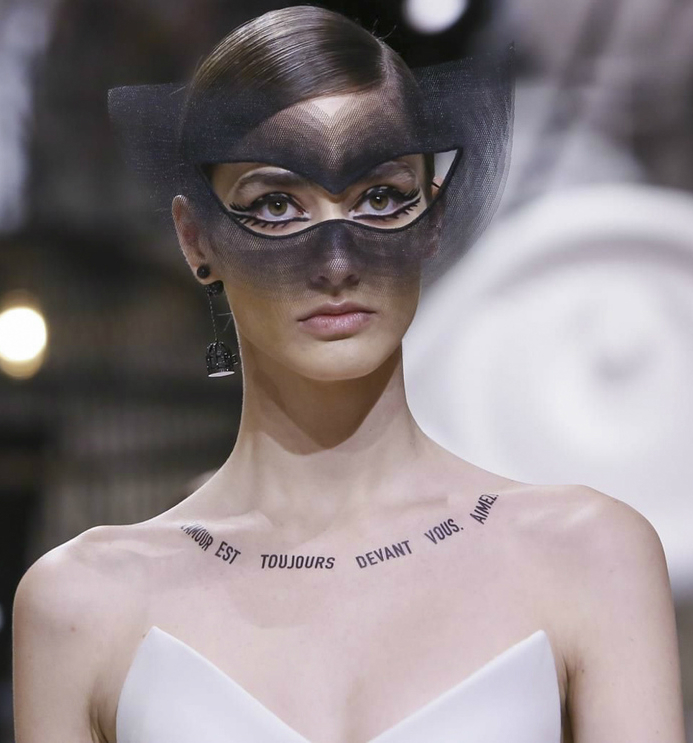
Dior Haute Couture SS18 finale: The list of Grand Couturiers that showed during Haute Couture SS18 fashion week included Givenchy, Alexandre Vauthier, Giambattista Valli, Julien Fournié, Jean Paul Gaultier, Stéphane Rolland, Christian Dior, Alexis Mabille, Franck Sorbier, Chanel, Schiaparelli and Maison Margiela. Image: Dior via WWD

Fashion is not just about high street stores, online shopping and $5 t-shirts. Fashion at its core is about the making of garments to fit and suit your body perfectly.

Who are the couturiers and what is haute couture?
With the current fashion trends focused almost entirely on streetwear and sportswear, it’s easy to forget that fashion used to come first from the delicate hands and exacting minds of the haute couture ateliers – the studios of ‘high elegant sewing’. Basically sewing by hand.

Over the years, however, it has come to be defined as being: ‘fashion that is constructed by hand from start to finish, made from high quality, expensive, often unusual fabric and sewn with extreme attention to detail and finished by the most experienced and capable sewers, often using time-consuming, hand-executed techniques’ (Huffington Post 2015).

The Chambre syndicale de la haute couture as it is now known was originally founded in 1868, and rigorously chooses a very limited number of 100 members in three groups or Chambres Syndicales – Haute Couture including Grand Couture, Couturiers’ and Fashion Designers’ Ready-to-Wear and Men’s Fashion as exemplars of quality fashion and design (Chambre syndicale de la haute couture 2018).

Of these three groups, to become a member of the Haute Couture Chambre Syndicale is considered the highest honour a fashion designer can aspire to (Chambre syndicale de la haute couture 2018).

Why should we care about haute couture ateliers?
Haute Couture can be defined as being the highest level of the creation of garments; the Chambre was founded to promote ‘Haute Couture and creation [to] have a major impact by combining traditional know how and contemporary technology at all times’ (Chambre syndicale de la haute couture 2018).

It is the work of these couturiers and their atelier teams that continue the core skills and history of handcrafting garments to perfectly fit a body. These handcrafting skills are the basis for every factory machine action that is used to create prêt-à-porter, or ready-to-wear clothing.

Without the continuation of revered ateliers like embroiderer Maison Lesage which partners with Chanel for its haute couture collections, so much knowledge and skill would be lost.

Without the couturiers and ateliers, there would be no fashion; just a lot of clothes.

Quality or sustainability … which is more important?

fashion criticism sustainable fashion quality fashion

As part of my current Masters of Fashion [Entrepreneurship] course I had to produce a blog – yes, I know, it’s basically my job :).

But there were some issues and think pieces that I think are worth sharing … this is the first one:

Quality or sustainability … which is more important?

Those of us working in the fashion industry system are supposed to be aware that ours is not currently a sustainable enterprise.

fashion criticism sustainable fashion quality fashion
Sewing is hard: I’ve had some experience learning to sew. Sewing is not too difficult if you know what you’re doing, but it is time consuming and fiddly. Most people who wear clothes have no idea what it takes to actually make them; whether to the costs to the environment or the costs to lives and livelihoods, just buying a t-shirt could become an ethical dilemma. Image: Niki Bruce

The general clothes-buying public, however, have probably no idea that their $5 t-shirts are harming not only the environment but that we might just end up eating the microfibres are clothes are made of (Bauck 2017).

Sustainability …
In a pointed post entitled ‘How many gallons of water does it take to make a single pair of jeans?’, influential fashion website The Fashion Law points out that just about everything we wear is somehow damaging our planet and therefore, the future of the fashion system (The Fashion Law 2018).

Until very recently I didn’t give much thought to the environmental impact of my love of shopping. I did rail against the rise of blogshops and fast fashion outlets, but that was more in support of independent designers being ripped off by multinational brands, than concern over the environment, or the sustainability of the fashion system as it now operates.

Quality …
Quality, I believe, is something that’s worth paying more for; you’re paying for the art and skills of a young designer who has put everything into creating something special for you to wear. Quality also equals unique or luxurious materials, handcrafted work, and a sense that the item will last forever. And, more often than not, quality fashion costs more.

Quality versus sustainability …
Are quality and sustainability the same thing? If we only buy quality items, are we being more sustainable? Or are quality items affecting sustainability? Should we just not buy anything? But then who will employ the millions of women in developing nations who currently work in the industry?

No clear conclusion …
Personally I find that I cannot come to a clear conclusion on this issue at this time. It is complicated, ongoing and there are more questions than answers.

I have decided, however, to give shopping a break and join the #shopyourwardrobe movement until I can come to a conclusion.

Note: As the issue of sustainability and ethics in fashion continues to be discussed, major fashion designers and emerging brands are offering a variety of thoughts and options that take the issues of quality and sustainability into account, and which are being picked up by mass media.

The stories below make for some interesting reading:
Derek Lam believes sustainability is the future of fashion
Is the use of feathers in fashion any more ethical than fur?
The huge impact of donated bras

I want every piece of the new Carrie K. fine jewellery Modern Heirloom collection

I’m in love with the new Modern Heirloom fine jewellery collection from Singapore artisan jeweller Carrie K.

Everyone who knows me even a little bit knows I love rings, and more recently, earrings. Likewise, they know that one of my favourite places to buy jewellery brands is from Singapore artisan jeweller, Carrie K.

So you can imagine my joy when I saw the first pieces of its newest collection, Modern Heirlooms.

singapore jeweller carrie k heritage fine jewellery collection 1
The Modern Heirloom fine jewellery collection. Image: Carrie K.

The thing that makes Carolyn Kan – the founder and designer of Carrie K – such an interesting jeweller, is her dedication to creating pieces that are somehow attached to her Singapore heritage but that look nothing like an obvious recreation.

There is always a certain consideration that Carolyn applies when she designs; she doesn’t take the most obvious route towards referencing ‘local flavour’, and generally designs first from a point of genuine interest and love for the things that make Singapore special. She also has a quirky sense of humour.

Carolyn is basically the nicest person in the world too. #justsaying

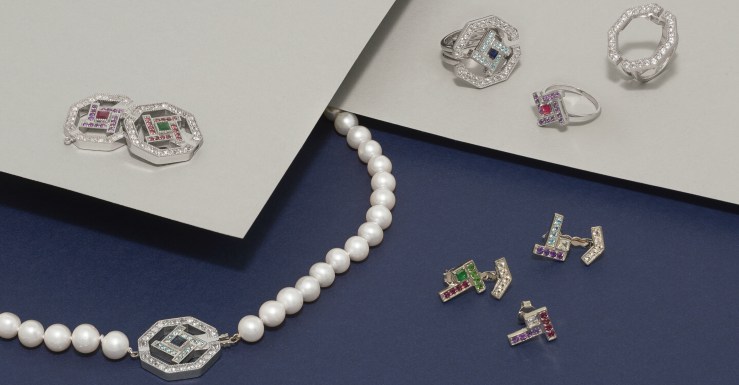
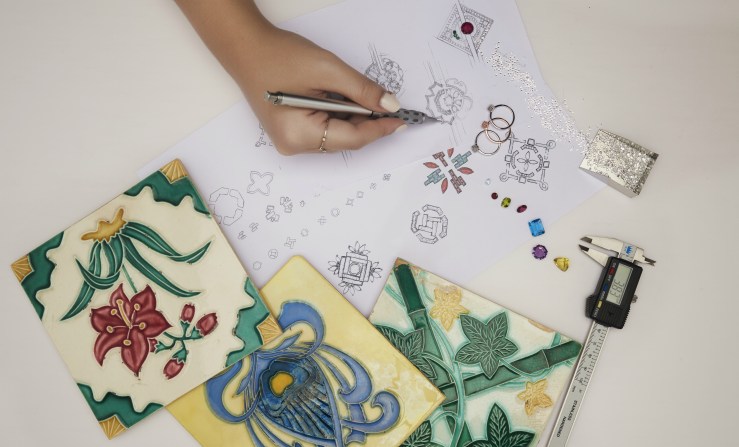
The new Modern Heirloom fine jewellery collection has been inspired by Singapore’s Peranakan heritage, in particular the colourful traditional tiles. But unlike just about every fashion student I’ve ever had the misfortune to critique, Carolyn didn’t just go with over-wrought patterns of teal, fuschia and lemon.  

singapore jeweller carrie k heritage fine jewellery collection 2
The Modern Heirloom fine jewellery collection. Image: Carrie K.

Although the designs were based on the stylised plants and animals of the traditional tiles that can be found across Singapore from Chinatown to Little India and Geylang Serai, when you look at the geometric and streamlined jewellery pieces the connection does not smack you in the face.

“The Modern Heirloom Collection was designed to create relevant interpretations of important elements of our Singapore Heritage in the hope that these meaningful reminders will be handed down to future generations,” says Carolyn.

There is a very Art Deco feel to the designs overall, including the sharp lines, the pearls and the fact that Carolyn chose to use white gold instead of yellow for the settings. The colours come from rubies, emeralds, blue sapphires and diamonds and well as semi-precious stones such as amethyst, peridot, topaz, and jade.

singapore jeweller carrie k heritage fine jewellery collection Heritage Long Pearl Necklace
The Modern Heirloom fine jewellery collection. Image: Carrie K.

As well as the refined, pared-back aesthetic, Carolyn has continued her penchant for mechanical things by fiddling with the designs to include multiple functions. There’s an ‘over ring’ that you wear with the core Heritage Rings; this creates an impressive cocktail ring that you can breakdown into a smaller everyday piece. As with all Carrie K. pieces, the designs come in a number of price points. Starting from only SG$288 for the silver version of the Heritage Outer Ring with topaz, that you pair with a silver and ruby, blue sapphire or emerald Heritage Ring for SG$388. You can also splash out on a luxe version that is made of 9 karat gold with a great emerald for SG$1,288.

singapore jeweller carrie k heritage fine jewellery collection Heritage Styled Ring Sapphire
The Modern Heirloom fine jewellery collection Heritage Ring. Image: Carrie K.

Another inspiration for Carolyn for the Modern Heirloom collection was Si Dian Jin – usually connected to weddings but actually based on the Chinese concept of ‘four generations under one roof’. You can also see echos of this concept in the architecture of the traditional Chinese four-pointed roof. That concept is where the overall design of the rings comes from – the outer ring with four ‘points’ and the inner ring with four stones that represent the four generations.

singapore jeweller carrie k heritage fine jewellery collection Heritage Ear Drops
The Modern Heirloom fine jewellery collection Heritage Ear Drops. Image: Carrie K.

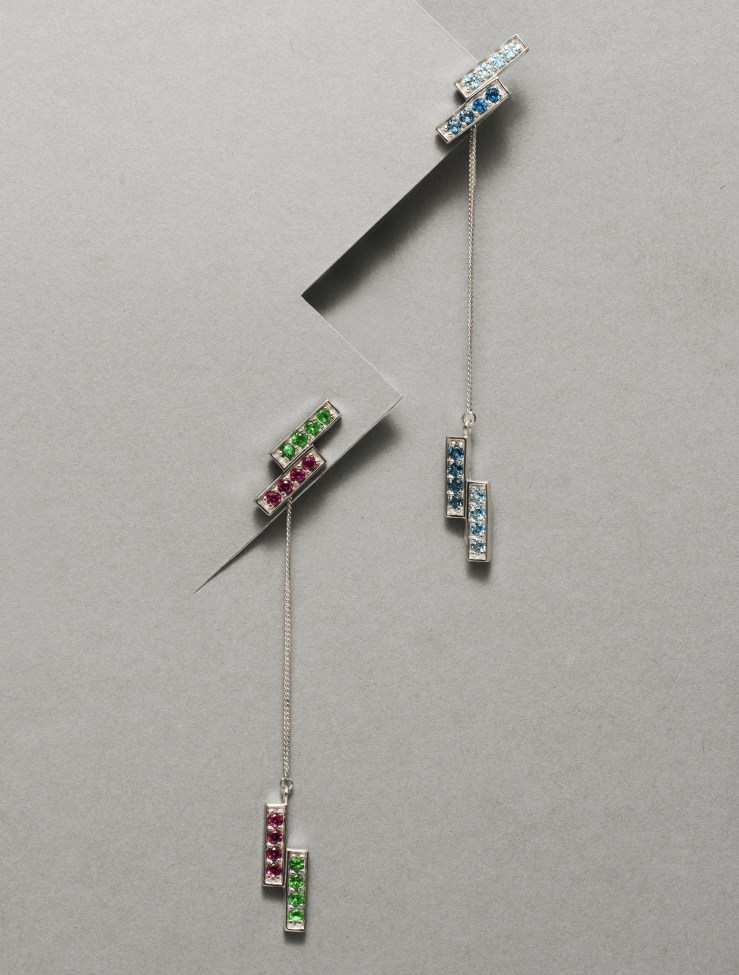
The rings are obviously my favourite pieces, but the earrings are damn nice too. Like the rings, the earrings are also multifunctional – the Heritage Ear Drops can be worn either as simple studs or with the additional ‘drops’ which you can buy separately. Prices range from $368 to $588 depending on the type of stones you choose. Top of the line is the pair that comes in 9 karat gold with amethyst and London blue topaz or white topaz which cost $1,488. I’m also loving the studs in rhodalite garnet or dark tarvorite garnet for $1,188.

Basically I’m impressed with the whole collection – as if that’s not obvious. I just have to work out how to pay for all the pieces I want.

The Carrie K. Heritage fine jewellery collection is available from the new Carrie K. Fine Jewellery Atelier located at #02-02 National Design Centre. The atelier will feature the custom and bespoke services, and you can shop for the ready-to-wear Carrie K. collection at the Keepers PlayShop at #01-01 National Design Centre.